We built Flint. The pricing decided the architecture.
·5 min read
A friend and I built a voice app. It is called Flint, it has been on the App Store since April, and it is on Android now. You talk, it writes. That is the entire product.
It is not a new idea. AudioPen has done it for years, Otter does it at enterprise scale, and Apple ships a version of it inside Voice Memos. So the interesting question is not what we built. It is why the thing we ended up with came out structurally different from the others, when none of us are smarter than the people at Otter.
The honest answer is that we made one decision early, and everything else fell out of it. We decided not to charge rent.
The renewal that stopped making sense
The trigger was mundane. I was paying about ninety dollars a year for a tool that turned rambling into paragraphs. It worked. I liked it. And every renewal I had the same thought, which is that I could not name what was being maintained on my behalf that justified ninety dollars a year, forever, for something I used for four minutes a day.
The transcription is a commodity. The summarisation is one model call. My notes are a few megabytes of text. Nothing about it is ninety dollars a year of ongoing work. It is ninety dollars a year because subscription is the best available business model, which is a different claim from it being the right price.
Pricing is architecture
Here is the part I did not appreciate until we were deep in it. A subscription is not just a way to collect money. It is a constraint that propagates all the way down into the technical design, and it does so quietly.
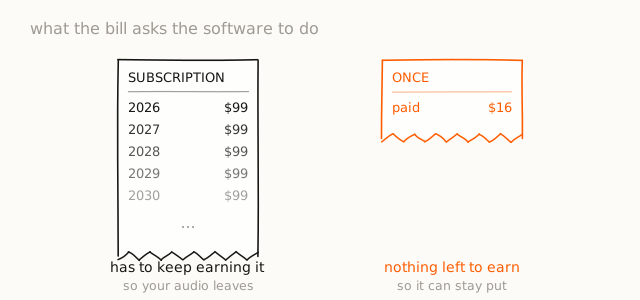
If you charge ninety dollars a year, you have to be worth ninety dollars a year again, every year. That pushes you toward the things you can keep improving on a server: better models behind an endpoint, dashboards, sync, sharing, a web app, a team plan. Server-side processing means the audio has to leave the device. Once the audio is sitting on your servers, keeping it is cheaper than deleting it, and now you have a corpus, and now the privacy policy grows a section about how it may be used to improve the service.
None of that is villainy. Every step is locally reasonable. It is simply what the business model asks for, and the people building it are answering the question they were given.
Charge once and the pressure reverses. There is no renewal to earn, so there is no reason to hold anything. We keep the audio on the phone and send only text to the cloud, and you can switch to full on-device mode where nothing leaves at all. I would like to claim that as a principled stand. It was not. Under our pricing it was also the cheap option, and the cheap option happening to be the right one is the whole argument of this note.
What that bought the user
The differences that people actually notice are all downstream of that one decision.
| Typical subscription app | Flint | |
|---|---|---|
| Recording length | Capped, often at 15 minutes | No limit. Record the two-hour drive. |
| Where the audio lives | Their servers | Your phone. Text only leaves, or nothing does. |
| Cost | 75 to 99 a year, indefinitely | Sixteen dollars, once |
| Platform | Often a web app in a shell | Native iOS and Android |
The recording cap is the clearest tell. A cap is not a product decision, it is a cost decision wearing a product costume. If the audio must cross your servers and you are on the hook for that bill every month, of course you cap it. We are not, so we did not.
Native mattered more than I expected, too. Live Activity, Dynamic Island, and background recording are not features anybody asks for by name, but they decide whether the app is there in the two seconds where you actually have the thought. A voice app you have to unlock and hunt for is a voice app you stop using.
The rest is ordinary craft. Four formats, because a grocery list and a lecture are not the same shape: a note, a todo checklist, a first-person story, or a custom one you define yourself. If the summary comes out wrong you add an instruction and regenerate it rather than starting over. And you can ask questions across everything you have ever recorded, which turns a pile of notes into something you can actually interrogate.
The part that felt reckless
Pro users can plug in their own Deepgram, OpenAI, or Anthropic key. Their key, their bill, which in practice rounds to nothing.
Every instinct I picked up working on funded products says do not do this. You are handing away the metered layer. That is the part that scales with usage, and usage is supposed to be how you grow.
If you are not renting the software out, the metered layer was never yours to begin with.
It was a toll we would have been collecting on a road somebody else built. Giving it up costs us the thing we already decided not to build a business on, and it buys the user a product whose running cost goes to roughly zero. That trade only looks reckless from inside the subscription frame.
What Flint is not
I would not trust this note if it only contained good news, so here is the other side.
On-device transcription is worse
Meaningfully worse than cloud transcription, particularly with an accent or background noise. It is free forever and it is genuinely private, and it will also mangle the occasional proper noun. Both things are true.
There are no teams
No shared workspaces, no CRM sync. If you need meetings piped into a pipeline, that is Klu, which is the other thing we work on and which does charge a subscription, because there the ongoing work is real.
One-time pricing is worse for us
Every month starts at zero and we have to keep finding new people instead of coasting on renewals. We think that is the correct incentive to be under. Ask again in two years.
Two people is slow
Some things simply take longer than they would with a team behind them. That is the trade for the price.
Where I land
I have spent a decade around products where the business model was decided first and the architecture arranged itself around it afterwards, usually without anyone saying so out loud. Flint is the first time I have watched that happen in the direction I actually wanted.
If you take one thing from this and never touch the app, take this: when you are trying to work out why a product treats you the way it does, look at how it bills you. The answer is nearly always there, and it was decided long before anyone opened a design file.
And if you do want the app, it is flintvoice.app. You talk, it writes.