The PM skill that got scarce this year
·2 min read
For about a decade, a large part of being a good product manager was being able to get things done. Unblock the thing. Land the release. Herd six functions toward a date. That was genuinely hard and genuinely valuable.
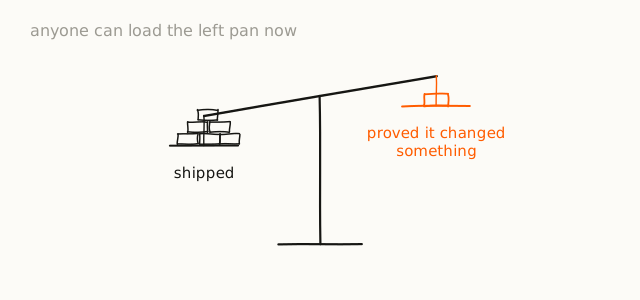
It got a lot less scarce this year.
Not because PMs got worse. Because execution got cheaper for everybody. When a designer can prototype it, an engineer can ship it in a day, and half the team is running the same frameworks through the same tools, the ability to make a thing happen stops being a differentiator.
What replaced it
Causal thinking. Being able to say what changed, for whom, because of what, and then defend that with something better than a chart that went up.
Most product reviews I sit in still stop two boxes early. We shipped it, the metric moved, everyone claps. Nobody asks whether the metric would have moved anyway, whether the users who moved are the ones we wanted, or whether we can do it again on purpose.
That last one is the real test. If you cannot repeat it deliberately, you did not learn anything. You got a result.
Questions I now ask in every review
- What did users do differently, in behaviour, not in sentiment
- What else changed in the same window (a campaign, a season, a competitor outage, a pricing test someone forgot to mention)
- Which segment moved, and is it the one we care about
- What would we have expected to see if this had not worked
- Can we do it again next quarter on a different surface
The fourth one catches the most self-deception, including mine. If you cannot describe what failure would have looked like, you were never really testing anything.
The AI angle, briefly
Everyone now has access to the same analysis tools. Which means everyone gets to the same first-order answer at roughly the same time. Run the same framework through the same model and you land where everyone else lands.
The differentiated thing left is judgment about which question to ask, and the willingness to sit with an answer that is inconvenient. Borrow the framework. Keep your own read on what it means.
How I would build this if I were earlier in my career
Write down your prediction before the launch. Sealed, dated, specific. "I think activation goes from 22% to 27% within three weeks, driven mostly by the mobile cohort."
Then check.
You will be wrong a lot at first. That is the point. Calibration only comes from being wrong in writing, and almost nobody does it because it is uncomfortable and nobody makes you.
Ten of those and you will be better at this than most people with twice your years.