Ten videos, one result: the economics of repurposing to Shorts, Reels and TikTok
·4 min read
The number everybody quotes about repurposing video comes from one creator reposting ten YouTube videos to Instagram and TikTok. The extra platforms brought in another 1,761,995 views, taking the total to 4,626,299. That is roughly a 62% lift, and it gets cited as though 62% is what repurposing does.
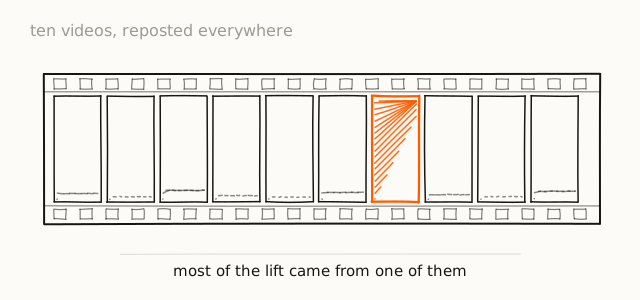
Read the rest of that write-up and two details change the meaning entirely. Eight of the ten videos still did best on YouTube. And most of the gain came from a single outlier.
So the headline is arithmetically true and practically misleading. Nobody got a 62% lift. One video went off, nine did very little, and the average reported the difference.
The distribution is the strategy
This is a power law, and power laws do not reward optimisation the way averages do. If outcomes were normally distributed, you would improve the median clip and watch everything rise. They are not, so you cannot.
What actually governs your results in a power law is how many attempts you get and what each one costs you. The payoff lives in the tail, and the only reliable way to reach a tail is to take more draws from the distribution.
AI tooling does not make a video better. It makes an attempt cheaper, which is the only lever that works against a power law.
That reframing is worth more than any individual tactic, because it tells you what to measure. Cost per attempt becomes the operating number. Not views, not engagement rate, not any of the things a dashboard offers you first.
What the evidence will and will not support
Having read a reasonable amount of what passes for research in this area, here is my honest sorting.
- Credible, with caveats. Watch time as a percentage of the clip is the signal that matters most for short-form distribution. This is consistent across sources, though none of them show their working.
- Credible and useful. Over 90% of views on Instagram and TikTok arrive through the feed rather than through search. If you came from SEO, this is the thing to internalise first, because your intuitions about intent and keywords do not transfer. Nobody is looking for you.
- Folklore, but cheap to test. The claim that the first three seconds decide everything is repeated everywhere without a controlled study behind it. I believe it directionally and I would never argue it from authority. Test it on your own content, because testing it costs almost nothing.
- Treat with suspicion. Platform scale figures contradict each other badly. Alphabet has said Shorts serves over 30 billion views a day. Vendor blogs cite over 100 billion. When a number varies by more than three times depending on who is selling, stop using it to justify anything.
How I would actually run it
The workflow follows from the economics, so it is deliberately boring.
- Drive the cost of an attempt toward zero. Clip detection, captioning, reformatting per platform and scheduling are all mechanical, and mechanical work is what models are genuinely good at. Every hour you remove from producing one clip is another draw from the distribution.
- Keep a human on the hook and the first line. This is the part that carries all the variance, so it is the last thing to automate. The model writes forty options, a person picks the one that sounds like a human being said it.
- Adapt per platform rather than cross-posting. The platforms expect different things, and a TikTok with a YouTube pace reads as an import. Reformatting is cheap, so there is no excuse.
- Judge the batch, never the clip. One video underperforming carries no information. Twenty videos underperforming is a signal about the format. Review in cohorts and you will stop overreacting to noise.
- Measure profile visits and follows, not views. Views are the lottery ticket. The follow is the compounding asset, and it is the only one that makes the next batch cheaper.
The part that does not scale
Volume solves the distribution problem and creates a second one, which is that an infinite supply of competent, forgettable clips is worth very little. The tail is reached by taking more draws, and a draw only counts if it has a real idea in it.
So the thing I would protect, if I were running this inside a company, is the supply of actual opinions. The workflow should take one genuine point of view and give it forty shots on goal. A workflow that generates forty points of view has automated the wrong half and will produce exactly the kind of content people scroll past without registering.
Where I land
Stop asking how to make a video perform. On this distribution that question has no useful answer. Ask instead what an attempt costs you today, then cut it in half, and keep the only two things that carry variance in human hands: the idea and the first three seconds.
Across 90 or more user acquisition campaigns at XHAI Studios I never once predicted which creative would be the outlier. I got better at making sure there were enough of them in flight that one of them could be.