GPT-6 Astra, Fable 5.1, and the number nobody is quoting
·5 min read
Three things happened in the first week of September 2026. Anthropic released Claude Fable 5.1 on the 1st. OpenAI released GPT-6 Astra on the 3rd. On the 6th, OpenAI president Greg Brockman said that if you fast forward a couple of years and look back at when AGI was created, "I think it's going to be about this time, and I think it might be about this model."
The AGI sentence took the coverage. It is also the least useful thing that happened that week, because no experiment you can run on Monday morning will settle it. Three other things from those six days will change what you build, and almost nobody is discussing them.
Why the AGI question does not survive contact with a roadmap
Toby Walsh, chief scientist at the UNSW AI Institute, gave the cleanest objection. Benchmarks measure, in his words, "a very specific part of AGI" rather than the whole of human intelligence.
I'd eat my hat if we didn't find trivial things that an eight-year-old can do that Astra fails at.
Rebecca Johnson at the University of Sydney made the methodological version of the same point: a high benchmark score "cannot by itself establish that a system has crossed into a fundamentally different category of intelligence." She also observed that OpenAI's own published definitions of AGI sit awkwardly beside the claims now being made for Astra.
I hold no position on whether Astra is AGI, and I would be wary of anyone who holds a confident one. My position is narrower. The question is unfalsifiable on any timescale that matters to a roadmap, so it belongs in the essays and not in your planning. The three things below are measurable, dated, and already priced.
One: capability stopped being the same for everybody
Anthropic released a single model under two names. Fable 5.1 is the generally available version, shipped with production safeguards. Mythos 5.1 is the same underlying model, released through restricted-access programmes to vetted cybersecurity and life-sciences organisations.
OpenAI did something structurally identical. Astra is the first model OpenAI has designated as reaching the "critical" cybersecurity threshold under its preparedness framework, which means it can find and exploit previously unknown vulnerabilities in well-defended systems without step-by-step human guidance. The rollout was staged and permission-gated: approved organisations on day one, then ChatGPT Plus, Pro, Business and Enterprise, then the API and AWS.
Both leading labs, in the same week, shipped a capability and declined to hand all of it to everyone at once. The practical consequence for anyone building on top is that the model your competitor calls may differ from the model you call, even when the version string in your config matches theirs. Capability has become a function of who you are, and that is a procurement question now, not an engineering one.
Two: the honest computer-use number is 41.7%
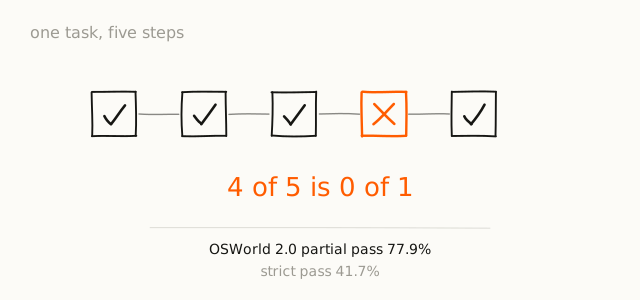
Fable 5.1 scores 77.9% on OSWorld 2.0 partial pass and 41.7% on strict pass. Both figures are real. Only one of them describes a finished job.
Partial pass means the agent completed some of a multi-step task on a real desktop. Strict pass means it completed the task. For a benchmark that gap is a scoring convention. For a product it is your entire support burden, because a half-finished action on a live system leaves somebody working out what state the machine is now in, and that costs more than never starting.
Four steps out of five is not eighty percent of a job. On any task that has to complete, four of five is zero of one. That single line is what I would put in front of an executive who read a launch post and now wants agents in the business by Q4.
The rest of the numbers are worth reading with the same eye. On Terminal-Bench-Science 0.1, an agentic scientific research benchmark, Fable 5.1 more than doubled its predecessor.
| Benchmark | Fable 5.1 | Fable 5 | Opus 5 |
|---|---|---|---|
| Terminal-Bench-Science 0.1 | 52.6% | 24.7% | 29.0% |
| AutomationBench | 31.4% | 17.1% | 26.9% |
| GDPval-AA v2 (knowledge work) | 1,853 | 1,723 | 1,824 |
| OSWorld 2.0 strict pass | 41.7% | not stated | not stated |
Doubling a research benchmark is genuinely remarkable. AutomationBench at 31.4% means roughly two out of three automation tasks still fail. Both sentences describe the same model on the same day.
Three: the price of the loop fell, and nothing else did
Anthropic cut Fable 5.1 cache reads by 75%, from one dollar per million tokens to twenty-five cents. Base input stayed at ten dollars per million and output stayed at fifty. Anthropic measures the effect as roughly 25% lower cost on typical workloads and up to 45% on agentic ones. Astra is priced at the same ten and fifty, with cached input at one dollar.
Read that as an architectural statement rather than a discount. The operation that got cheaper is re-reading the same context repeatedly, which is precisely what an agent does every time it loops. The operation that did not get cheaper is generating new tokens. They have made iteration affordable and left production priced where it was.
I argued earlier this year that pricing decides architecture, that a business model propagates quietly into technical design long before anyone opens a design file. This is that, running in the other direction. The labs are telling you, in the only language that cannot be marketing, which shape of product they expect you to build next. Long-running agents that re-read a large context many times just became the cheap thing to do.
What I would actually do about it
- Write your own eval set before you write your integration. Forty labelled examples of the specific task you care about will tell you more than any published benchmark, because the benchmark measures a general capability and you are betting on a narrow one.
- Score strict, never partial. Decide what "done" means for your task, then measure only that. If your internal number looks like the vendor's headline number, you are probably scoring partial credit without realising it.
- Find out which model you are actually entitled to. Ask your vendor, in writing, whether your account has access to the same weights and the same safeguards as the tier above you. That sentence would have sounded paranoid in January.
- Design the rollback before the agent. Anything with computer-use access needs a defined way to reverse whatever it half-finished, and that is a product decision rather than an infrastructure one.
- Reprice your roadmap. If your unit economics assumed expensive context re-reads, they are now wrong by 25% to 45% on agentic workloads, and something you shelved in June may be viable in September.
Where I land
Astra may or may not be the moment somebody points at in five years. I have no useful opinion on that and neither does anyone selling you a framework this month. What I can say is that a model which finds novel exploits without hand-holding, ships behind a permission gate, completes 41.7% of real desktop tasks end to end, and just made looping 75% cheaper, describes a product landscape that is different from August in ways you can actually plan around.
The AGI debate resolves in retrospect or not at all. Your eval set resolves on Friday. Spend the week on the one that answers.