Generative engine optimization is a measurement problem
·5 min read
Ask an answer engine the same question five times and you will get five different sets of citations. Not slightly different. Different brands, different sources, different order. One analysis of 45,000 citations found that only 30% of brands stayed visible between two consecutive answers, and only 20% survived five runs in a row.
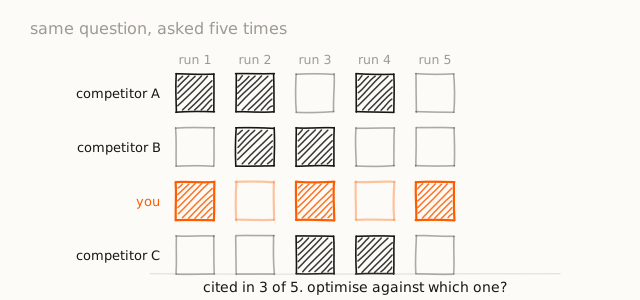
Every piece of generative engine optimization advice I have read assumes a stable target. Write the comparison page, add the schema, earn the mention, watch the citation arrive. That advice is built on a measurement that flickers, and almost all of it is published by companies selling GEO tools.
I run growth for products that need organic to work, so I had to decide what to actually do about this. What follows is the loop I ended up with, and the reasoning, which matters more than the tool list.
What the evidence actually supports
Very little, and it is worth being precise about that before anyone spends a quarter on it.
The foundational GEO paper came out of KDD in 2024. The figure everyone quotes from it, that verifiable statistics and named citations lift AI visibility by 30% to 40%, appears in blog summaries far more often than it appears with a page reference. A 2026 SIGIR paper argues the bigger problem is that most GEO evaluations ignore competition for the handful of citation slots an answer actually has. A separate 2026 study sorts citation failures into parsing, fetching and generation stages, and concludes that optimisation cannot fix all three.
Meanwhile the 2026 guidance published by Google says that optimising for generative search is still just SEO. That sentence is doing more work than most of the GEO industry would like.
So the honest position is this. Clear, well sourced, current pages do better. Beyond that, the specific tactics are mostly unvalidated, and the measurement underneath them is noisy enough that a single reading tells you close to nothing.
Why one audit is a coin flip
Here is the practical consequence. If you run an AI visibility check on Monday and your brand appears, you have learned almost nothing. Run it again on Tuesday and there is a meaningful chance you are gone, with no change to your site in between.
Any workflow built on a single reading will produce confident recommendations from noise. Teams then act on those recommendations, see the number move for unrelated reasons, and conclude the tactic worked. I have watched that cycle happen with keyword rankings for a decade and the only thing that has changed is the speed.
Instability does not mean you give up measuring. It means you measure repeatedly and look at the distribution instead of the reading.
The loop, and why each part is there
Sample the same prompts on a schedule
The series is the unit of measurement here, never the individual check. I track a fixed prompt set and run it repeatedly, then look at citation frequency across runs rather than presence in any one. A brand cited in 3 of 5 runs and a brand cited in 1 of 5 look identical on a Monday audit and are not remotely the same position.
Keep the crawl and the citation data in the same place
Most of the failures are boring. A page that an engine cannot fetch or parse cannot be cited no matter how good the copy is, and that 2026 failure study puts parsing and fetching ahead of generation as causes. Site audit data and AI visibility data belong in one view, because the fix is usually in the first one.
Anchor everything to Search Console
Impressions and clicks are the only numbers in this stack that come from the destination rather than from a sampler. When an AI visibility trend and the Search Console trend disagree, I believe Search Console. It is measuring what happened. The other one is measuring what a model said when asked.
Close the loop on revenue, not traffic
Product analytics is where the whole thing either justifies itself or does not. Organic sessions that never activate are a vanity line. I care about which entry page produced an account that was still there in thirty days, and that question lives in the product database, not in any SEO tool.
Let the model read the whole picture, not run the strategy
The useful job for Claude here is synthesis across sources that do not talk to each other, and drafting the comparison pages the research suggests get cited. The decision about what to publish stays with the person who has talked to customers. A model asked to pick a content strategy will produce a plausible one every time, and plausible is the failure mode.
What I measure, and what I deliberately ignore
| Signal | Why it earns a place | How I read it |
|---|---|---|
| Citation frequency across runs | Survives the volatility problem | Trend over weeks, never a single reading |
| Crawl and parse errors | A common upstream cause of zero citations | Fix before touching copy |
| Search Console impressions | Measured at the destination | The tiebreaker when sources disagree |
| Activation by entry page | Connects organic to revenue | The only number I report upward |
| Domain authority scores | Third-party estimate, not a ranking input | Ignored |
| A single AI visibility score | One sample of a noisy distribution | Ignored unless it is part of a series |
Domain authority deserves a note. It is a vendor estimate of how a vendor thinks a search engine might behave. It moves, it feels like progress, and no search engine consumes it. I watch it the way you watch a thermometer in another room.
What I will not claim
I will not tell you this produced a specific lift, because the honest version is that organic growth takes two or three quarters to read and anybody quoting a clean before and after from a six-week window is quoting noise.
What I can point at is older and duller. At LuxTag I grew organic search traffic 150% year on year, in an era when the measurement was far more stable than it is now, and the thing that produced it was the same discipline: fix the technical layer first, publish for a specific buyer, measure at the destination, and wait longer than feels comfortable before concluding anything.
The tooling got dramatically better. The patience requirement did not move at all.
Where I land
Treat generative engine optimization as a measurement problem before you treat it as a content problem. The content advice is mostly unproven and the measurement is mostly noise, so the first real advantage available is simply sampling properly while your competitors read single numbers off a dashboard and believe them.
Build the loop. Run the same prompts on a schedule, keep the crawl data beside the citation data, anchor to Search Console, and report activation rather than sessions. Then go and write something a human would want to cite, which is the part no workflow will ever do for you.