Chat is a hedge, not an interface
·5 min read
Every AI product I have worked on began with a text box. Not because anyone designed a text box, but because at the start you do not know what people will ask for, and a text box is the only control that accepts everything.
That is worth saying plainly, because we have spent three years treating the result as a design. Chat is not a design. It is a hedge against not having made one yet.
What a text box actually costs
An interface is compressed knowledge. A dropdown is somebody deciding the set of valid answers. A slider is somebody deciding the range, and deciding that the value is continuous. A confirm dialog is somebody deciding this action is worth interrupting you for. Every control in good software is an argument that was settled before you arrived.
A text box settles nothing. It hands the design work back to the user, at runtime, every time. We named this prompting and we discuss it as a skill. It is closer to unpaid work, and we assign it to the person with the least information about what the system can actually do.
The cost stopped being a matter of taste
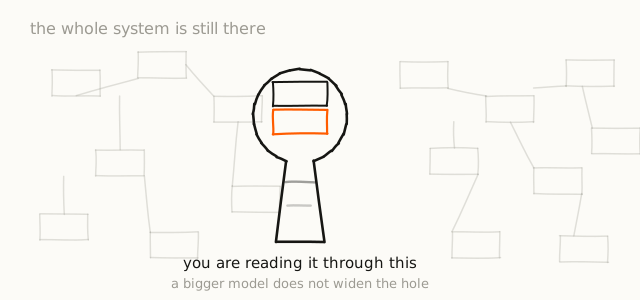
A paper from February put numbers on the thing I had only been able to gesture at. It calls the problem a keyhole effect, and it argues that chat degrades analytical work through mechanisms that are cognitive rather than aesthetic. New text displaces old text, which defeats the spatial memory people use to track where things are. Forcing everything through language triggers verbal overshadowing, which measurably degrades visual pattern recognition. Hidden state exceeds working memory, which under load holds about four chunks.
The part I keep returning to is how it defines overload: what the task requires, minus what is visible on screen, minus what a person can hold in their head. Anything above zero is where the errors come from, and it is also where anchoring and change blindness get amplified.
Read that as a product decision and it says something uncomfortable. You reduce overload by raising what is visible. There is no model improvement that raises human working memory. A smarter model does not fix a keyhole. It produces more things you cannot see at once.
Three shapes that are not chat
The alternatives are further along than the discourse suggests. Three are solid enough to build on now:
| Shape | What it fixes | What it costs |
|---|---|---|
| Generative UI | The agent returns controls instead of prose. You verify by looking and adjust by clicking. | An interface nobody can learn by heart |
| Ambient and background agents | No interface during the work at all. One surface, at approval time. | Trust, and a very good diff |
| In place and deictic | You point at the thing instead of describing it. The artifact carries the context. | Deep integration with one surface |
The standards arrived faster than I expected. MCP Apps and Google's A2UI both landed as ways for an agent to hand back an interface rather than a paragraph, and they disagree in a way worth understanding. A2UI sends a description of native components. MCP Apps sends sandboxed HTML. Declarative against executable. That argument decides how much of your screen an agent is allowed to control, and I would watch it more closely than the model releases.
All three make the same move
Chat puts the model in a conversation. Every one of these puts it in an artifact. The document, the dashboard, the pull request, the calendar. The output stops being a message you have to read and becomes an object you can inspect, sort, undo, and hand to someone else.
Gartner projected 40% of enterprise applications would ship task-specific agents this year, against under 5% the year before. The growth is not the interesting part. The interesting part is that almost none of those agents are a chat window. They are a step inside something that already existed.
The bottleneck moved to review
Here is where I think most teams are still pointed the wrong way.
Generation got cheap. Review did not. When a model writes one paragraph, reading it is free. When it opens fourteen pull requests overnight, your entire cost is working out which ones are wrong. The scarce resource in an AI product is no longer the model's output. It is the human attention spent approving that output.
Chat is close to the worst available surface for that. You cannot diff a paragraph. You cannot sort six proposals by risk when they arrive as six messages. You cannot glance at a conversation and see what changed. Every review affordance built over forty years of software, the diff, the sorted list, the highlighted delta, the undo, got thrown out the moment we decided the answer should be prose.
So the design question is not what the AI should be able to do. It is what the user will have to verify, and how fast they can say no. Build for fast rejection. The products that win the next two years are the ones where rejecting a wrong answer takes one second and costs nothing.
What I would not build
I would not generate the interface fresh on every request, and I think that is where generative UI goes wrong first.
Consistency is a feature. People get fast at software through muscle memory, and muscle memory needs the button to be in the same place tomorrow. An interface assembled per request is an interface nobody ever becomes expert in. Demos never show this cost, because a demo is always somebody's first use.
The narrow version works: generate the parts that genuinely depend on the data, keep the frame fixed. The controls can be dynamic. The furniture should not be.
And chat holds one virtue none of the alternatives have. It is the same box every day, it accepts anything, and it never makes you hunt for the feature. That makes it a poor primary interface and an excellent escape hatch, which is roughly the inverse of how most products use it today.
Where I land
- Use chat for intent, not for state. The moment a user has to remember something the screen is not showing, you have built a keyhole.
- Ask what the user must verify before you ask what the model should do. That answer picks the interface for you.
- Put the output in an artifact people already know how to review before inventing a new one.
- Keep the frame stable and generate inside it.
The interesting work in AI right now is not happening in the model. It is happening in the six inches between a correct answer and a person who can tell that it is correct.