Bookbind. The hard part was the spine width.
·5 min read
I have been building something called Bookbind. You type one sentence about the book you have been meaning to write, and it hands back the files a printer will actually accept. Interior PDF, cover wrap, EPUB, and the Amazon listing, ready to upload.
The obvious way to describe that is "AI writes your book", and I think the obvious description is the least interesting thing about it. It is also the version that invites the only criticism anyone bothers making, which is that the world does not need more machine-written books.
So let me describe it the way it actually happened. The writing was never the bottleneck.
What actually stops a book
Any competent model could draft a book-length manuscript two years ago. People have been generating chapters into chat windows since 2023. Almost none of those became books.
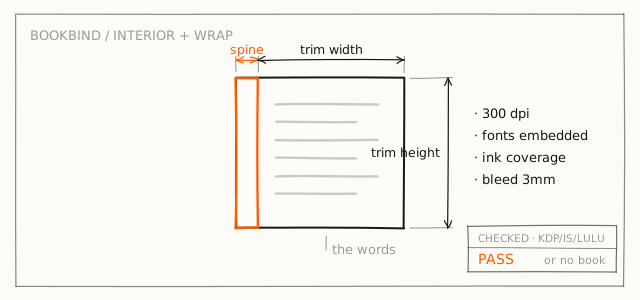
What stopped them was everything after the text. A paperback interior needs the right trim size, margins that account for the gutter, and bleed on any art that runs to the edge. The cover is not an image, it is a single wrap whose spine width is computed from your page count and your paper stock, so it cannot even be drawn until the interior is final. Fonts have to be embedded. Ink coverage has to stay under the press limit. The EPUB has to validate. Then Amazon wants seven keywords and two categories chosen from a taxonomy you have never read.
None of that is creative work. It is format compliance, and it is invisible until it rejects you. It is also, I think, where the overwhelming majority of "I am writing a book" projects quietly end. Not at chapter four. At the upload screen.
Gradient problems and binary problems
Here is the distinction I keep coming back to, because it is the thing that made me want to build this at all.
Prose quality is a gradient. A chapter can be excellent, fine, or flat, and every point in between is still a chapter. You can ship a merely decent book. People do, constantly.
Printer compliance is binary. Your spine is either correct to the millimetre for that page count on that paper, or the cover wrap is rejected and you have no book at all. There is no partial credit. A manuscript that fails preflight has sold exactly zero copies, no matter how good the writing is.
Now notice which of those two an LLM is actually suited to, and which one humans find soul-destroying. Gradient problems are where models are genuinely uncertain and human judgement matters most. Binary constraint problems are deterministic, tedious, thoroughly documented, and completely unforgiving. That is the least glamorous work in publishing and the most obviously automatable, and almost every AI writing tool skips it to compete on prose instead.
So Bookbind checks every file against the specs of Amazon KDP, IngramSpark and Lulu before you can download it: page size, margins, embedded fonts, ink coverage, page count. If a printer rejects one anyway, that is our problem to fix, not yours.
The output is a file, not a conversation
I wrote a note recently arguing that the useful move in AI products right now is getting the model out of a conversation and into an artifact you can inspect and hand to someone else. Bookbind is the most literal version of that I have built.
Nothing useful comes out of it as a message. What comes out is a folder.
- Print interior PDF.
300 DPI, with margins and gutters at printer spec. - Full cover wrap. Back, spine and front, sized to your actual page count.
- EPUB. Kindle, Apple Books, Kobo, anywhere else that sells ebooks.
- Listing copy. Description, seven keywords and categories, ready to paste.
- Preflight report. Your files checked against three printers before you download them.
You can hold that. You can upload it. You can hand it to someone who has never heard of the tool that made it, which is the actual test of whether an AI product produced something real.
The objection I take seriously
The concern about a flood of generated books is legitimate and I am not going to wave it away, partly because I built a thing that lowers the barrier and partly because I have read some of what is already up there.
What I will say is that the barrier being removed is not the one people assume. Bookbind does not make you a person with something to say. It removes the manufacturing tax on people who already had something to say and no route to a printer. Whether that trade is good depends entirely on which of those two you are, and the tool cannot tell the difference.
The part I insisted on is that we say what it produces. It is a strong first draft. The product tells you so, in the FAQ, in those words. Read it, edit what needs your judgement, check the facts. Planning and previewing cost nothing precisely so you can look at the work before deciding it is worth money. A tool that let you go from sentence to storefront without ever reading the middle would be a worse product, and I would not want to have made it.
What it does not do
- It does not edit. It drafts, and drafting is the part that was already easy. The judgement is still yours and there is no version of this where it is not.
- It does not market. Getting the file accepted is a solved problem now. Getting anyone to buy it is not, and that gap is much wider than people expect.
- Illustrated formats are slow, because every page is genuinely drawn. A text book is one sitting. A picture book is not.
- It takes no share of your royalties, which means the whole thing has to be worth paying for up front. That is a harder business and I think it is the correct one.
Where I land
Every few months someone asks what the good AI products will look like once the novelty burns off. I think they will look boring from the outside. They will not be the ones with the cleverest model. They will be the ones that took a job with a hard, unambiguous, checkable definition of done and did all of it, including the ninety percent nobody puts in the demo.
The model writing your chapters is the part that impresses people. The spine width is the part that decides whether the book exists.
It is at bookbind.co, and you can plan and preview a whole book without paying anything, which is the only way I would want to be judged on it.